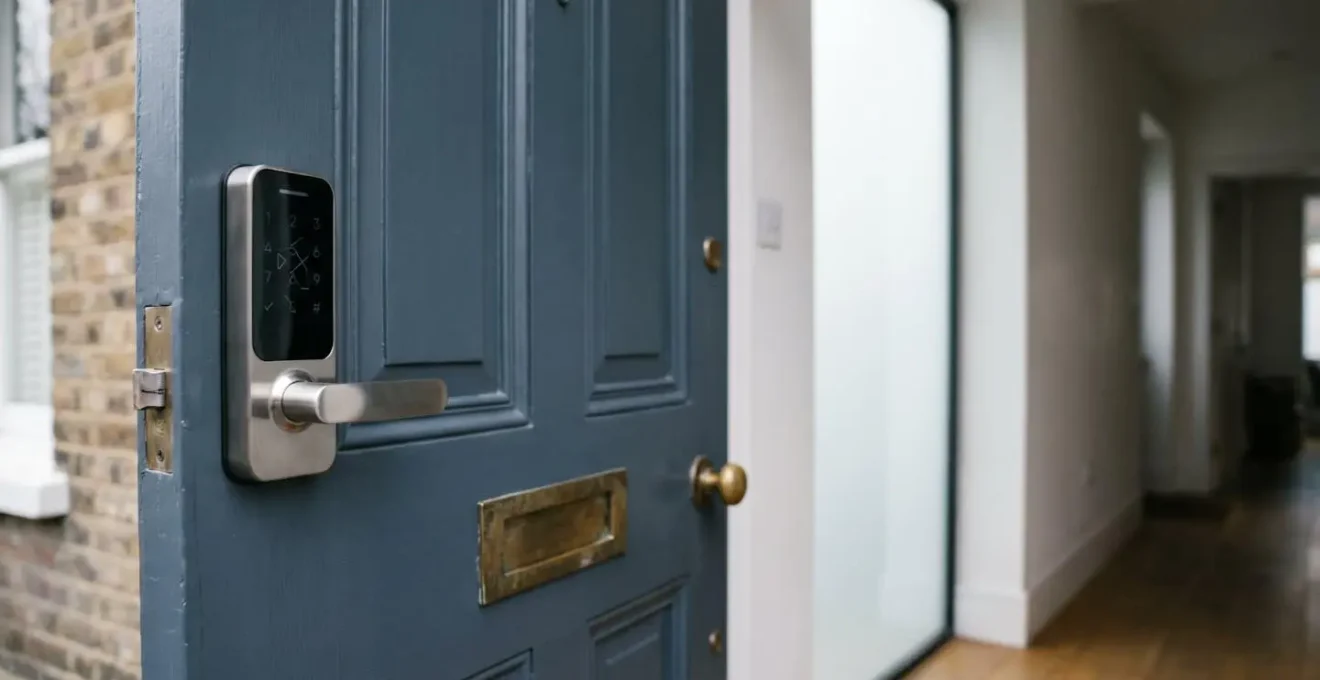
Your smart lock’s compliance with UK insurance isn’t determined by the brand, but by its ability to prove an unbroken “chain of security custody” to your insurer.
- A certified smart lock (TS 621 Kitemark) is the baseline, equivalent to the old BS 3621 standard for mechanical locks.
- Insurers care most about evidence of forced entry; a smart lock’s digital log provides this, but only if the data itself is secure and encrypted.
Recommendation: Shift your focus from “which lock is approved?” to “how does this lock system allow me to prove my door was securely locked at the time of an incident?”
The move to a keyless home promises a future of convenience and control. Yet, for UK homeowners, this modern dream is often clouded by a nagging fear: will this high-tech gadget invalidate the very home insurance policy meant to protect them? The common advice is frustratingly vague, often boiling down to “check your policy” or look for a “BS 3621” rating, a standard designed for the mechanical locks we’re trying to leave behind. This advice, while not wrong, misses the fundamental shift in thinking required.
The truth is, insurers are not inherently against technology. They are against ambiguity. When assessing a burglary claim, their primary concern is not the brand of your lock but a single, crucial question: was there a sign of forced entry? If your lock can be bypassed digitally without a trace, you create a black hole of evidence, turning a potential claim into a case of uninsurable negligence. The conversation must therefore pivot from the lock as a simple barrier to the lock as a data-rich source of evidence.
This guide reframes the entire debate. We will operate from the perspective of an insurance compliance officer, focusing not just on features, but on evidentiary integrity. The key isn’t the lock; it’s the log. It’s about maintaining a provable, unbroken “chain of security custody” for your home’s most critical access point. We will explore the specific standards that matter, the vulnerabilities you must mitigate, and how to ensure your smart lock’s data log becomes your strongest ally, not your weakest link, in the event of a claim.
This article provides a comprehensive framework for homeowners, demystifying the technical standards and compliance requirements for integrating smart locks without jeopardising your insurance coverage. Here is a breakdown of the critical areas we will explore.
Summary: Will a Smart Lock Invalidate Your UK Home Insurance? The Answer Isn’t the Lock Itself
- Why You Must Look for the TS621 Kitemark on Any Smart Lock?
- How to Grant Temporary Access to Cleaners Without Giving a Key?
- Phone Battery Dead: How to Enter Your Home Without a Physical Key?
- The Bluetooth Vulnerability That Thieves Use to Open Smart Locks
- How to Automate Unlocking When You Verify a Visitor via Camera?
- Why Cloud-Based Health Data Needs More Than Just a Password?
- Signal vs Telegram: Which App Actually Encrypts Your Chats by Default?
- Why End-to-End Data Encryption Matters for Legal Firms Handling Client Files?
Why You Must Look for the TS621 Kitemark on Any Smart Lock?
For decades, the “BS 3621” Kitemark was the undisputed symbol of an insurance-approved mechanical lock in the UK. This standard guaranteed resistance to common forms of physical attack, like drilling and picking. When smart locks arrived, they presented a new challenge: how to certify a device against both physical and digital threats? The industry’s answer is the TS 621:2018 standard. Think of it as the digital-era successor to BS 3621. It’s not just a suggestion; for an insurer, it is the first and most critical checkbox.
This standard was developed specifically to address the concerns of homeowners and insurers alike, with research showing that nearly half of UK homeowners express concern about the security of smart devices. As security firm ERA explains, “TS 621:2018 is a technical standard from the Door and Hardware Federation in response to a market requirement for third party certification of residential thief resistant electronic door locking devices.” This means a TS 621-certified lock has been independently and rigorously tested against a battery of modern attack methods, covering both its mechanical strength and its electronic security.
Choosing a non-certified lock is a significant gamble. In the event of a burglary, an insurer could argue you failed in your “duty of care” to secure your property by using a substandard device. The presence of the TS 621 Kitemark immediately negates this argument, proving you have met the established industry benchmark for security. It shifts the liability away from your choice of product and back to the evidence of the incident itself. Without this certification, you are starting on the back foot, forced to prove your lock was not the point of failure. With it, you have a solid foundation for any potential claim.
How to Grant Temporary Access to Cleaners Without Giving a Key?
One of the most compelling use cases for a smart lock is the ability to grant temporary access to service providers like cleaners, dog walkers, or contractors without the inherent risk of handing over a physical key. A lost or copied key represents a permanent, untraceable vulnerability. A digital code, however, offers granular control, creating a clear and auditable access event. This is where the concept of “security integrity” becomes tangible. You aren’t just letting someone in; you are creating a temporary, logged, and revocable permission set.
The process involves generating a unique, time-sensitive PIN code or a digital “key” through the lock’s companion app. This code can be set to work only on specific days and during specific hours—for example, every Friday between 10 AM and 12 PM. Once the time window expires, the code becomes useless. This eliminates the risk of a key falling into the wrong hands or a service provider attempting unauthorised access outside of agreed times. Furthermore, every time the temporary code is used, the event is logged in the lock’s activity feed, providing a definitive record of who entered your home and when. This is a powerful tool for both peace of mind and, crucially, for your insurer.
This log provides a clear “chain of custody” for your home’s access. In a dispute or security incident, you can present a definitive, time-stamped record that refutes any ambiguity. To maintain this integrity, it’s vital to follow best practices for managing these temporary credentials. Setting up notifications for when a code is used, for example, provides real-time awareness and an additional layer of oversight. The goal is to leverage the technology to eliminate variables, turning what was once a trust-based system (handing over a key) into a verifiable, data-backed process.
Action Plan: Setting Secure Temporary Access Codes
- Define Precise Windows: Set specific start and end times for every code (e.g., ‘Friday 10:00 a.m. – Friday 12:00 p.m.’). Avoid creating indefinite or “always-on” guest codes.
- Categorise Users: Create and assign separate, unique codes for different individuals or groups (e.g., Cleaner, Dog Walker, Family Guest) to allow for clear individual tracking in the access log.
- Immediately Revoke Access: As soon as a service is complete or a guest has departed, manually delete or disable their temporary code to eliminate any lingering, unnecessary access windows.
- Enable Real-Time Alerts: Configure your smart lock app to send a push notification to your phone the moment a temporary code is used. This provides immediate awareness of who is entering your property.
- Integrate with Your System: If possible, link your smart lock to your wider home security system. This can pair access events with video verification from a doorbell camera for an undeniable record.
Phone Battery Dead: How to Enter Your Home Without a Physical Key?
A primary concern for those considering a keyless lifestyle is the potential for a single point of failure: what happens if your phone—your new key—runs out of battery? Or if the lock’s own batteries die? This is a valid question that separates poorly designed products from insurance-compliant, thoughtfully engineered solutions. A lock that leaves you stranded because of a dead battery is not just an inconvenience; it’s a design flaw that compromises its reliability. Manufacturers of reputable smart locks have engineered several “graceful degradation” pathways to prevent this scenario.
Firstly, the lock itself provides ample warning. Most leading UK smart lock models send battery warnings at thresholds like 20% and 10%, delivering notifications to your phone and often displaying a visual indicator on the lock itself. This is designed to give you weeks, not hours, of notice to replace the standard AA batteries. Secondly, many high-security models retain a physical keypad. This provides a secondary method of entry via a PIN code, completely independent of your phone’s status. It’s a crucial layer of redundancy.
But what if you ignore the warnings and the lock’s internal batteries die completely? Even here, top-tier models have a contingency. This is where the engineering demonstrates a true understanding of security and reliability.
Case Study: Yale’s 9V Emergency Jump-Start
Yale Conexis smart locks, popular in the UK, feature an elegant solution to total battery failure. Hidden on the exterior of the lock are two small, discreet terminals. If the internal batteries are completely depleted, the user can simply press a standard 9V battery against these terminals. This provides just enough temporary power to the lock’s electronics to allow the user to enter their PIN code or use a paired key fob to gain entry. This design ensures that the homeowner is never truly locked out, providing a reliable emergency override without compromising the lock’s day-to-day security by including a vulnerable key cylinder.
The Bluetooth Vulnerability That Thieves Use to Open Smart Locks
While smart locks eliminate the risk of picked cylinders and copied keys, they introduce a new attack surface: the wireless spectrum. The most common connection protocol, Bluetooth Low Energy (BLE), is brilliantly efficient but can be a point of vulnerability if not implemented correctly. The theoretical risk involves a “man-in-the-middle” attack, where a thief could potentially intercept and replay the “unlock” command sent from your phone to your lock. However, this is far from a simple or common threat for any properly secured device.
The defence against this is robust encryption. It is the digital equivalent of the complex wards inside a high-security mechanical key. As security researchers note, “Smart-locks using Bluetooth can be vulnerable to man-in-the-middle attacks if there is no encryption. Most of them use AES encryption for the keys used in Bluetooth communication and have obfuscated the Android app code.” The key phrase here is “if there is no encryption.” Any smart lock worth considering, and certainly any lock bearing the TS 621 Kitemark, will use a powerful encryption standard like AES 128-bit or 256-bit. This wraps the communication between your phone and your lock in a layer of cryptographic protection that is, for all practical purposes, unbreakable by brute force.
This means that even if a thief were able to “listen in” on the Bluetooth signal, they would only capture a stream of encrypted gibberish, not a repeatable unlock command. The lock and the phone perform a secure “handshake” each time, using rolling codes and encrypted keys to ensure that each command is authentic and unique. For a homeowner, the takeaway is not to fear Bluetooth, but to verify the level of encryption used by the lock manufacturer. A lack of clear information on encryption standards is a major red flag, signalling a product that prioritises convenience over fundamental security integrity.
How to Automate Unlocking When You Verify a Visitor via Camera?
The holy grail of the smart home is seamless integration: your video doorbell sees a recognised face and automatically unlocks the front door. While technically possible, this level of automation introduces significant security and liability risks that give insurers pause. A false positive from a facial recognition algorithm or a compromised Wi-Fi signal could lead to your door unlocking for a complete stranger. From a compliance perspective, full automation removes a critical element: intent and accountability.
The most secure and insurance-friendly approach is not full automation, but a “human-in-the-loop” system. This is a conditional protocol where technology proposes an action, but a human must give the final confirmation. For example, your doorbell camera detects a visitor. You receive a notification on your phone with a live video feed. You see it’s your expected guest. Within that same notification, you are presented with a button: “Unlock Door.” You press it, the action is authenticated, and the door unlocks. This process maintains a clear chain of command and accountability. You, the homeowner, made the conscious decision to grant access at that specific moment.
Security professionals emphasize that conditional security protocols integrating smart locks with home automation systems should trigger multiple verification actions simultaneously rather than automatic unlocking. The most secure implementations enable the system to identify a visitor and propose unlocking, requiring explicit user confirmation to maintain a clear chain of accountability—a ‘human-in-the-loop’ approach that prevents liability issues from false positives.
– Smart Home Wizards Security Research, Remote Access Management
This approach is critical in the context of the more than 224,000 burglary offences recorded in England and Wales annually. By requiring explicit user confirmation, you create an auditable event that can be cross-referenced with video footage and the lock’s own data log. It proves that the door was not opened due to a system glitch but by a deliberate, authorised command. This human-in-the-loop model provides the perfect balance of convenience and the robust, evidence-based security that insurers require.
Why Cloud-Based Health Data Needs More Than Just a Password?
In the world of data security, health records are considered among the most sensitive categories of personal information, protected by stringent regulations. The principles that guard this data—confidentiality, integrity, and availability—are directly applicable to the access logs generated by your smart lock. From an insurer’s perspective, the log of who entered your home and when is not just a feature; it’s a piece of evidence as sensitive as a legal or medical file. Therefore, its protection requires more than just a simple password.
A simple password on the cloud account managing your lock can be phished, guessed, or stolen. This could allow an attacker to not only access your home but, just as critically, to delete or alter the access logs, destroying the “chain of custody” and making it impossible to prove what happened during a security incident. This is why multi-factor authentication (MFA) is non-negotiable. By requiring a second form of verification—such as a code sent to your phone or a fingerprint scan—MFA ensures that even if your password is compromised, your security data remains secure.
The British Standards Institution (BSI) recognized this convergence of physical and digital security when it created the BSI IoT Kitemark, a certification achieved by locks like the Yale Conexis L1. This certification doesn’t just test the lock’s resistance to being physically forced open; it rigorously assesses the security of the entire digital ecosystem, including the app, the cloud service, and the data transmission. It treats the lock’s access data with the same level of scrutiny applied to sensitive records, establishing a benchmark for data custodianship. When choosing a smart lock, you are not just buying hardware; you are appointing a company to be the custodian of your home’s most critical security data.
Signal vs Telegram: Which App Actually Encrypts Your Chats by Default?
In the world of secure messaging, a critical distinction exists between apps like Signal, which encrypts every message by default (end-to-end encryption), and apps like Telegram, where this level of security is an optional feature (“Secret Chats”) that must be actively enabled. This same distinction applies directly to smart locks and is a crucial point of due diligence for any homeowner. A secure smart lock, like Signal, should have encryption as an automatic, non-negotiable, “always-on” feature. An insecure lock treats it as an afterthought, if it’s included at all.
A lock that communicates in plaintext or with weak encryption is the equivalent of sending your “unlock” command on a postcard for anyone to read. Reputable, insurance-compliant locks are built on a “zero-knowledge” architecture. This means the manufacturer itself cannot access your unique encryption keys or decrypt your access data. The keys are stored securely on your device and on the lock itself. For example, leading UK smart locks like the Linus Lock implement robust security protocols including AES 128-bit and TLS encryption, creating a secure tunnel for all communication.
This comparison highlights the core security principle at stake. When you choose a smart lock, you must ask: is security the default, or is it an optional extra? The table below starkly contrasts the security models, making it clear why an insurer would favour a system built on a foundation of default encryption, much like the difference between a secure messaging app and an open conversation.
| Security Feature | Signal (E2EE Default) | Telegram (E2EE Optional) | Secure Smart Locks | Insecure Smart Locks |
|---|---|---|---|---|
| Encryption by Default | Yes – All communications | No – Must enable Secret Chats | Yes – AES-256 built-in | No – Optional or weak |
| Zero-Knowledge Architecture | Yes – Company cannot access data | Partial – Server has some metadata | Yes – Keys stored locally only | No – Cloud keys accessible |
| Protection Level | Data in transit + at rest | Data in transit (Secret Chats only) | Commands + logs encrypted | Commands only (if any) |
| Metadata Protection | Maximum – Hides communication patterns | Limited – Server logs connections | Variable – Depends on manufacturer | None – Full activity logged |
| UK Insurance Compliance Equivalent | Meets highest standards | May not meet requirements | BSI IoT Kitemark (TS621) | No certification – Risk of claim denial |
Key Takeaways
- Insurance compliance for smart locks hinges on the TS 621 Kitemark, the digital equivalent of the old BS 3621 standard.
- The core of a successful claim is proving forced entry; a smart lock’s encrypted, un-tampered access log is your primary evidence.
- Adopt a “human-in-the-loop” approach for remote unlocking, requiring explicit confirmation rather than full automation to maintain a clear chain of accountability.
Why End-to-End Data Encryption Matters for Legal Firms Handling Client Files?
A legal firm is entrusted with privileged information. They have a professional and ethical duty to maintain a strict chain of custody for every document, ensuring it is not accessed, altered, or destroyed without authorisation. This is the exact mindset a homeowner must adopt towards their smart lock’s data log. That log is, in essence, a “legal file” for your home. It’s the primary evidence you will present to your insurer to prove the circumstances of a security breach.
As experts at Lock Shop Warehouse explain, “In case of a burglary, the critical factor for most insurers is whether there are signs of forced entry. A smart lock can actually enhance security by automatically ensuring that your door is locked.” This is true, but it’s only half the story. If a burglar can bypass the lock digitally without leaving a trace, you are left with no “signs of forced entry.” Your only remaining evidence is the digital log. If that log is unencrypted, stored insecurely, or can be easily erased, it has no evidentiary value. It’s like a legal file written in pencil.
End-to-end encryption ensures the integrity and authenticity of that file. It proves that the log—showing the door was locked at 10:00 PM and was not opened with a valid digital key before a window was smashed at 3:00 AM—is an accurate and untampered record. This is precisely the kind of evidence required to satisfy an insurer’s need for proof. The failure to use a certified lock is akin to a lawyer leaving client files in an unlocked car; it’s a breach of the duty of care. UK insurance claim denials often hinge on this very point: the homeowner’s failure to implement and document certified security measures, thereby creating ambiguity that the insurer is not obligated to cover.
Ultimately, by choosing a TS 621-certified lock and managing its data with the same diligence as a sensitive file, you are not just installing a gadget. You are building a robust, evidence-based security framework that protects both your property and your insurance policy. To put these principles into practice, the next logical step is to audit your current or prospective lock against these standards of evidentiary integrity.